
When people start working on their health and fitness, the first thing they often notice is the number on the weighing scale. But body weight is only one part of the picture. You can lose weight without losing a significant amount of body fat, and you can also lose body fat while the number on the scale changes very little.
Understanding the difference between weight loss vs fat loss can help you choose a better approach to nutrition, exercise, and long-term health.
What Is Weight Loss?
Weight loss means a reduction in your overall body weight.
Your body weight includes:
- Body fat
- Muscle
- Water
- Glycogen
- Bone
- Other body tissues
So, when the number on the scale decreases, it does not always mean you have lost body fat.
For example, changes in your food or carbohydrate intake can cause your body to lose water, leading to a quick drop in scale weight. This is different from losing stored body fat.
Zetofit tip: A healthy Weight Loss Program should focus on more than simply reducing the number on the weighing scale. Nutrition, physical activity, muscle mass, sleep, and daily habits all play a role in sustainable weight management.
What Is Fat Loss?
Fat loss means reducing the amount of stored body fat.
For many people, this is actually what they mean when they say they want to lose weight. They may want to reduce their waist size, lose excess abdominal fat, improve their body shape, or become fitter and stronger.
A good Personalized Weight Loss Plan should take these goals into account instead of focusing only on scale weight.
Fat loss generally involves creating an appropriate calorie deficit while maintaining good nutrition and regular physical activity. Strength training and adequate protein intake can also help support muscle maintenance during a fat-loss phase.
“The goal isn’t simply to weigh less. It’s to build a healthier body while losing excess fat sustainably.”
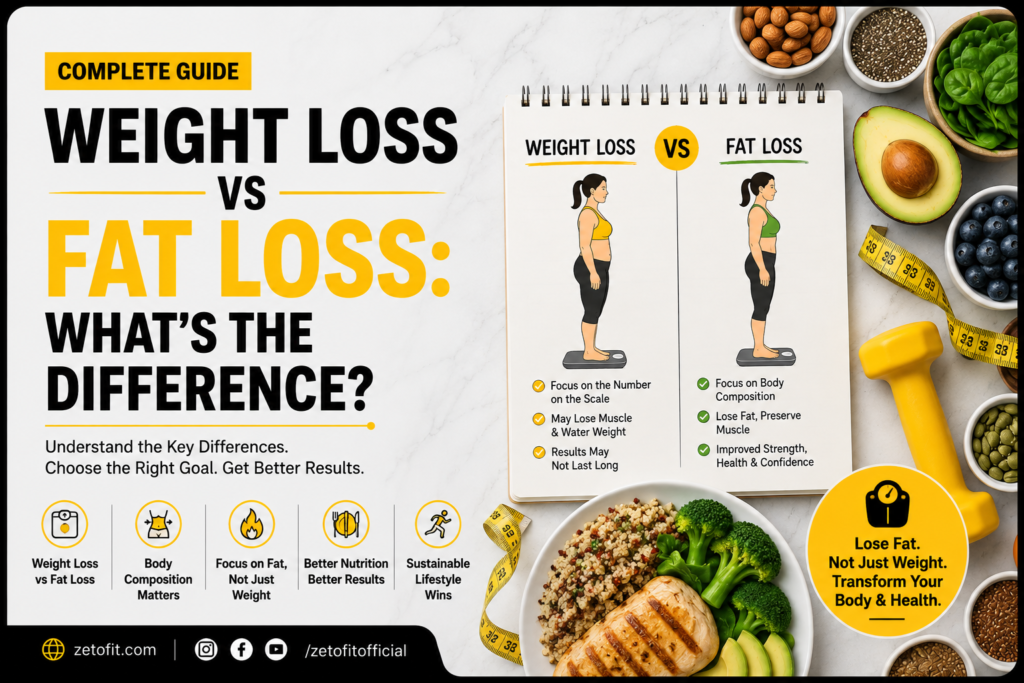
Weight Loss vs Fat Loss: What Is the Difference?
The simplest way to understand weight loss vs fat loss is:
| Weight Loss | Fat Loss |
|---|---|
| Reduction in total body weight | Reduction in stored body fat |
| Can include water, muscle, glycogen, and fat | Specifically focuses on reducing body fat |
| Often measured using a weighing scale | Can be assessed using waist measurements, body composition, photos, and other progress markers |
| Scale weight may change quickly | Fat loss generally requires consistent nutrition and activity over time |
Weight loss can include water, muscle, and fat. Fat loss specifically focuses on reducing body fat.
For example, two people could each lose 5 kg, but the changes in their body composition could be very different. One person may lose a combination of water, muscle, and fat, while another may lose primarily body fat while maintaining muscle.
This is why a successful Weight Loss Coaching approach should not depend entirely on the weighing scale.
Why Does Body Weight Change So Much?
Your body weight naturally changes from day to day.
Factors such as:
- Water retention
- Salt intake
- Carbohydrate intake
- Food volume
- Digestion
- Exercise
- Hormonal changes
- Sleep
can all affect your weight.
Because of this, one day’s weigh-in does not tell you whether you have gained or lost body fat.
Instead of focusing on daily fluctuations: look at your weight over several weeks and combine it with other progress measurements such as waist size, photos, strength, and how your clothes fit.
How to Focus on Fat Loss
1. Follow a Sustainable Nutrition Plan
Your food choices have an important role in fat loss. A suitable Weight Loss Nutrition Plan should provide enough nutrients and fit your lifestyle, preferences, and daily routine.
Rather than completely eliminating certain foods, focus on balanced meals that include appropriate amounts of protein, vegetables, fruits, whole grains, healthy fats, and other nutritious foods.
A sustainable Weight Loss Diet Plan should also be realistic enough for you to follow consistently.
2. Maintain an Appropriate Calorie Deficit
Fat loss generally requires your body to use more energy than it receives from food over time. However, eating as little as possible is not the goal.
A very restrictive diet can be difficult to maintain and may make it harder to get enough protein, vitamins, minerals, and other nutrients.
The right calorie intake can vary from person to person depending on factors such as age, sex, body size, activity level, and individual goals.
3. Include Strength Training
Strength training is an important part of improving body composition. Resistance exercises can help you build or maintain muscle while you work toward reducing body fat.
Your Weight Loss Training routine could include exercises such as:
- Squats
- Lunges
- Push-ups
- Rows
- Presses
- Deadlifts
- Core exercises
The exact exercises and training volume should depend on your fitness level and individual requirements.
4. Eat Enough Protein
Protein plays an important role in maintaining and repairing muscle. Including an appropriate source of protein in your meals can support your training and help you maintain muscle while working toward fat loss.
Depending on your dietary preferences, protein sources may include eggs, dairy products, paneer, chicken, fish, beans, lentils, soy, and other protein-rich foods.
5. Stay Physically Active
You do not need to spend hours in the gym to become more active.
Walking, cycling, swimming, sports, household activities, and regular workouts can all contribute to your daily activity levels.
The goal is to find activities that you enjoy and can maintain consistently.
6. Get Enough Sleep
Sleep is often overlooked when people are trying to lose weight.
Poor sleep can affect energy, recovery, appetite, and your ability to stay consistent with healthy habits.
A complete Weight Management Program should therefore consider lifestyle factors such as sleep and stress alongside nutrition and exercise.
Can You Lose Fat Without Losing Weight?
Yes.
This can happen when you lose body fat while maintaining or gaining muscle.
For example, your weight may remain around the same while:
- Your waist measurement decreases
- Your clothes fit better
- Your strength improves
- Your body looks more defined
- Your body-fat percentage decreases
This is sometimes referred to as body recomposition. It is one reason why progress should not be measured using body weight alone.
“A slower change on the scale does not always mean slower progress.”
How Should You Track Your Progress?
If you are following a Personalized Weight Loss Plan, consider tracking several different measurements instead of relying only on your weighing scale.
Body Weight
Weigh yourself consistently under similar conditions and look at the longer-term trend rather than individual daily changes.
Waist Measurement
Measuring your waist can provide useful information about changes in your body size.
Progress Photos
Taking photos at regular intervals can help you notice changes that may not be obvious from the scale.
Strength and Fitness
If you are able to perform more repetitions, lift more weight, walk longer, or complete workouts more easily, that can also indicate progress.
How Your Clothes Fit
Changes in how your clothes fit can sometimes become noticeable even before major changes appear on the scale.
Do You Need a Weight Loss Coach?
A Weight Loss Coach can help you create structure around your nutrition, exercise, and daily habits.
This can be particularly useful if you have tried different diets or workout plans but struggle to stay consistent.
Instead of following the same plan as everyone else, a coach can help you work toward realistic goals based on your lifestyle, current fitness level, food preferences, and progress.
For people who prefer remote guidance, an Online Weight Loss Program can provide coaching and support without requiring you to visit a physical centre for every session.
Weight Loss Program vs Quick-Fix Diet
There is a major difference between following a structured program and trying a short-term diet.
A quick-fix diet may focus primarily on reducing calories or eliminating specific foods.
A properly planned Weight Loss Program should take a broader approach that includes nutrition, physical activity, habits, and long-term consistency.
The objective should be to develop habits that you can continue even after reaching your initial goal.
What Should You Look for in a Weight Loss Plan?
1. Standard Ketogenic Diet (SKD)
The classic version — very low carb, moderate protein, high fat. Where most beginners start, and what most research is based on.
2. Cyclical Ketogenic Diet (CKD)
Strict keto for several days, followed by short higher-carb windows — e.g. 5 keto days, 2 higher-carb days. Mostly used by athletes.
3. Targeted Ketogenic Diet (TKD)
Small amounts of carbs added around workouts to fuel intense training, while staying in ketosis the rest of the day.
4. High-Protein Ketogenic Diet
Similar to standard keto but with a higher protein ratio — useful for preserving or building muscle while burning fat.
Zetofit tip: New to keto? Stick with the Standard Ketogenic Diet first. The cyclical and targeted versions suit people who’ve already fat-adapted and have specific training goals.
Indian Keto Meal Plan (Sample Day)
Keto doesn’t have to mean giving up Indian flavours entirely — it just means rethinking the base of your meals.
● BREAKFAST
Masala Omelette & Paneer Bhurji
3-egg masala omelette cooked in ghee, served with paneer bhurji on the side.
● MID-MORNING
Nuts & Black Coffee
A handful of almonds or walnuts with black coffee or bulletproof coffee.
● LUNCH
Grilled Paneer or Chicken Tikka
Served with sautéed spinach, cauliflower rice, and a cucumber-tomato salad with olive oil.
● EVENING SNACK
Cheese Cubes or Boiled Egg
Cheese cubes, roasted makhana in moderation, or a boiled egg.
● DINNER
Coconut Fish or Mutton Curry
Fish curry made with coconut milk, or mutton curry, served with sautéed greens — no rice or roti.
Portion sizes and macros should be adjusted based on your body weight, activity level, and specific goals — this is a starting template rather than a fixed plan for everyone.
Foods to Eat vs Avoid
| ✅ Eat Freely | 🚫 Avoid |
|---|---|
| Ghee, butter, coconut & olive oil | Rice, roti & grain-based staples |
| Eggs, chicken, fish, mutton, paneer, tofu | Sugar, jaggery & sweets |
| Spinach, cauliflower, broccoli, capsicum, cucumber | Potatoes & starchy vegetables |
| Cheese, full-fat curd, cream (moderation) | High-sugar fruits (mango, banana, grapes) |
| Almonds, walnuts, chia & flax seeds | Rajma, chana & most dals in bulk |
| Small portions of berries | Packaged snacks with hidden carbs |
Common Mistakes on Keto
⚠️ Not eating enough fat: Under-eating fat on keto often leaves you hungry, tired, and more likely to quit.
⚠️ Ignoring electrolytes: Cutting carbs flushes out sodium, potassium, and magnesium faster than usual — a major cause of “keto flu.”
⚠️ Hidden carbs: Sauces, packaged snacks, and even some “healthy” foods can sneak in more carbs than expected.
⚠️ Not tracking macros initially: Especially in the first few weeks, tracking helps you understand your actual carb intake.
⚠️ Expecting overnight results: Ketosis and fat adaptation take a couple of weeks before energy levels fully adjust.
Exercise on Keto
In the first 1–2 weeks of keto, your workout performance may dip slightly as your body shifts fuel sources — this is normal and temporary. Once fat-adapted, many people find steady, sustained energy for lower-to-moderate intensity training like walking, yoga, and steady-state cardio.
High-intensity training can feel harder on strict keto since it typically relies on quick-access glucose. That’s exactly why the Targeted Ketogenic Diet exists — a small amount of carbs around workouts supports performance while keeping the rest of your day in ketosis.
Who Should Avoid the Keto Diet?
Keto isn’t suitable for everyone. Speak with a healthcare professional before starting if you:
- Have type 1 diabetes or are on insulin
- Have a history of kidney disease or gallbladder issues
- Are pregnant or breastfeeding
- Have a history of disordered eating
- Are on medication that requires medical supervision around major dietary changes
Final Tips for Beginners
- Start by gradually reducing carbs instead of cutting them overnight
- Prioritize electrolytes — sodium, potassium, and magnesium — from day one
- Track your macros for the first few weeks to understand your intake
- Don’t fear fat — it’s your primary fuel source on keto
- Give your body at least 2–3 weeks before judging whether keto is working for you
Myths About the Keto Diet
| Myth | Fact |
|---|---|
| Keto means unlimited fat with no weight gain. | Calories still matter — ketosis changes fuel source, not whether a surplus causes weight gain. |
| Keto is dangerous for everyone’s kidneys and heart. | Generally safe short-to-medium term for healthy adults; existing conditions need medical guidance first. |
| You need ketosis to lose weight. | Weight loss comes down to a calorie deficit — keto is one method to get there, not the only one. |
| Keto results are permanent once you stop. | Like any diet, results depend on what follows — stopping without a plan can lead to regaining weight. |
Final Thoughts
The keto diet can be a genuinely effective tool for weight loss and appetite control, especially for people who respond well to low-carb, high-fat eating. But it’s not a one-size-fits-all solution — it requires real planning, attention to electrolytes, and patience while your body adapts to burning fat for fuel instead of carbs.
For Indian eaters especially, keto means rethinking meals built around rice, roti, and dal, which takes some getting used to. Success isn’t just about cutting carbs; it’s about making sure the rest of your plate — the fats, the protein, the vegetables — genuinely supports your goals and your health.
If you’re unsure whether keto fits your lifestyle, medical history, or fitness goals, working with a nutrition professional can help you figure out whether it’s the right approach, or whether a different eating pattern would get you there more sustainably.
Frequently Asked Questions
How long does it take to enter ketosis?
Can vegetarians follow a keto diet in India?
What is keto flu and how long does it last?
Is keto safe for long-term use?
Can I build muscle on a keto diet?
Ready to Start Your Weight Loss Journey?
At Zetofit, we help you achieve sustainable results through personalized nutrition guidance, fitness coaching, and lifestyle support.
📞 +91 93018 55272 ✉️ contact@zetofit.com 🌐 www.zetofit.com
Book Your Consultation →Related Blogs
Intermittent Fasting for Weight Loss: Does It Really Work?
How IF works, its benefits, fasting methods, and beginner tips for sustainable results.
How Much Does a Nutritionist in Pune Charge Per Month
Monthly fees, packages, and what you should expect from a nutritionist in Pune.
How 16:8 Fasting & Intermittent Fasting Helps
Why the scale isn’t moving even when you’re eating less, explained.
About Zetofit
Zetofit is dedicated to helping individuals achieve sustainable health through personalized nutrition, fitness coaching, and lifestyle transformation. Our evidence-based approach focuses on long-term wellness rather than quick fixes.
When people start working on their health and fitness, the first thing they often notice is the number on the weighing scale. But body weight is only one part of the picture. You can lose weight without losing a significant amount of body fat, and you can also lose body fat while the number on the scale changes very little.
Understanding the difference between weight loss vs fat loss can help you choose a better approach to nutrition, exercise, and long-term health.
What Is Weight Loss?
Weight loss means a reduction in your overall body weight.
Your body weight includes:
- Body fat
- Muscle
- Water
- Glycogen
- Bone
- Other body tissues
So, when the number on the scale decreases, it does not always mean you have lost body fat.
For example, changes in your food or carbohydrate intake can cause your body to lose water, leading to a quick drop in scale weight. This is different from losing stored body fat.
What Is Fat Loss?
Fat loss means reducing the amount of stored body fat.
For many people, this is actually what they mean when they say they want to lose weight. They may want to reduce their waist size, lose excess abdominal fat, improve their body shape, or become fitter and stronger.
A good Personalized Weight Loss Plan should take these goals into account instead of focusing only on scale weight.
Fat loss generally involves creating an appropriate calorie deficit while maintaining good nutrition and regular physical activity. Strength training and adequate protein intake can also help support muscle maintenance during a fat-loss phase.
“The goal isn’t simply to weigh less. It’s to build a healthier body while losing excess fat sustainably.”
Weight Loss vs Fat Loss: What Is the Difference?
The simplest way to understand weight loss vs fat loss is:
| Weight Loss | Fat Loss |
|---|---|
| Reduction in total body weight | Reduction in stored body fat |
| Can include water, muscle, glycogen, and fat | Specifically focuses on reducing body fat |
| Often measured using a weighing scale | Can be assessed using waist measurements, body composition, photos, and other progress markers |
| Scale weight may change quickly | Fat loss generally requires consistent nutrition and activity over time |
Weight loss can include water, muscle, and fat. Fat loss specifically focuses on reducing body fat.
For example, two people could each lose 5 kg, but the changes in their body composition could be very different. One person may lose a combination of water, muscle, and fat, while another may lose primarily body fat while maintaining muscle.
This is why a successful Weight Loss Coaching approach should not depend entirely on the weighing scale.
Types of Keto Diets
Effective Fat Loss
Burning fat for fuel, combined with appetite suppression, often leads to noticeable weight loss.
Fewer Cravings
Fat and protein are more satiating than carbs, so most people naturally eat less without feeling deprived.
Better Blood Sugar Control
Cutting carbs significantly can help stabilize blood sugar and insulin response.
Steadier Energy & Focus
Many keto followers report more stable energy once fully fat-adapted, since ketones fuel the brain reliably.
Types of Keto Diets
1. Standard Ketogenic Diet (SKD)
The classic version — very low carb, moderate protein, high fat. Where most beginners start, and what most research is based on.
2. Cyclical Ketogenic Diet (CKD)
Strict keto for several days, followed by short higher-carb windows — e.g. 5 keto days, 2 higher-carb days. Mostly used by athletes.
3. Targeted Ketogenic Diet (TKD)
Small amounts of carbs added around workouts to fuel intense training, while staying in ketosis the rest of the day.
4. High-Protein Ketogenic Diet
Similar to standard keto but with a higher protein ratio — useful for preserving or building muscle while burning fat.
Zetofit tip: New to keto? Stick with the Standard Ketogenic Diet first. The cyclical and targeted versions suit people who’ve already fat-adapted and have specific training goals.
Indian Keto Meal Plan (Sample Day)
Keto doesn’t have to mean giving up Indian flavours entirely — it just means rethinking the base of your meals.
● BREAKFAST
Masala Omelette & Paneer Bhurji
3-egg masala omelette cooked in ghee, served with paneer bhurji on the side.
● MID-MORNING
Nuts & Black Coffee
A handful of almonds or walnuts with black coffee or bulletproof coffee.
● LUNCH
Grilled Paneer or Chicken Tikka
Served with sautéed spinach, cauliflower rice, and a cucumber-tomato salad with olive oil.
● EVENING SNACK
Cheese Cubes or Boiled Egg
Cheese cubes, roasted makhana in moderation, or a boiled egg.
● DINNER
Coconut Fish or Mutton Curry
Fish curry made with coconut milk, or mutton curry, served with sautéed greens — no rice or roti.
Portion sizes and macros should be adjusted based on your body weight, activity level, and specific goals — this is a starting template rather than a fixed plan for everyone.
Foods to Eat vs Avoid
| ✅ Eat Freely | 🚫 Avoid |
|---|---|
| Ghee, butter, coconut & olive oil | Rice, roti & grain-based staples |
| Eggs, chicken, fish, mutton, paneer, tofu | Sugar, jaggery & sweets |
| Spinach, cauliflower, broccoli, capsicum, cucumber | Potatoes & starchy vegetables |
| Cheese, full-fat curd, cream (moderation) | High-sugar fruits (mango, banana, grapes) |
| Almonds, walnuts, chia & flax seeds | Rajma, chana & most dals in bulk |
| Small portions of berries | Packaged snacks with hidden carbs |
Common Mistakes on Keto
⚠️ Not eating enough fat: Under-eating fat on keto often leaves you hungry, tired, and more likely to quit.
⚠️ Ignoring electrolytes: Cutting carbs flushes out sodium, potassium, and magnesium faster than usual — a major cause of “keto flu.”
⚠️ Hidden carbs: Sauces, packaged snacks, and even some “healthy” foods can sneak in more carbs than expected.
⚠️ Not tracking macros initially: Especially in the first few weeks, tracking helps you understand your actual carb intake.
⚠️ Expecting overnight results: Ketosis and fat adaptation take a couple of weeks before energy levels fully adjust.
Exercise on Keto
In the first 1–2 weeks of keto, your workout performance may dip slightly as your body shifts fuel sources — this is normal and temporary. Once fat-adapted, many people find steady, sustained energy for lower-to-moderate intensity training like walking, yoga, and steady-state cardio.
High-intensity training can feel harder on strict keto since it typically relies on quick-access glucose. That’s exactly why the Targeted Ketogenic Diet exists — a small amount of carbs around workouts supports performance while keeping the rest of your day in ketosis.
Who Should Avoid the Keto Diet?
Keto isn’t suitable for everyone. Speak with a healthcare professional before starting if you:
- Have type 1 diabetes or are on insulin
- Have a history of kidney disease or gallbladder issues
- Are pregnant or breastfeeding
- Have a history of disordered eating
- Are on medication that requires medical supervision around major dietary changes
Final Tips for Beginners
- Start by gradually reducing carbs instead of cutting them overnight
- Prioritize electrolytes — sodium, potassium, and magnesium — from day one
- Track your macros for the first few weeks to understand your intake
- Don’t fear fat — it’s your primary fuel source on keto
- Give your body at least 2–3 weeks before judging whether keto is working for you
Myths About the Keto Diet
| Myth | Fact |
|---|---|
| Keto means unlimited fat with no weight gain. | Calories still matter — ketosis changes fuel source, not whether a surplus causes weight gain. |
| Keto is dangerous for everyone’s kidneys and heart. | Generally safe short-to-medium term for healthy adults; existing conditions need medical guidance first. |
| You need ketosis to lose weight. | Weight loss comes down to a calorie deficit — keto is one method to get there, not the only one. |
| Keto results are permanent once you stop. | Like any diet, results depend on what follows — stopping without a plan can lead to regaining weight. |
Final Thoughts
The keto diet can be a genuinely effective tool for weight loss and appetite control, especially for people who respond well to low-carb, high-fat eating. But it’s not a one-size-fits-all solution — it requires real planning, attention to electrolytes, and patience while your body adapts to burning fat for fuel instead of carbs.
For Indian eaters especially, keto means rethinking meals built around rice, roti, and dal, which takes some getting used to. Success isn’t just about cutting carbs; it’s about making sure the rest of your plate — the fats, the protein, the vegetables — genuinely supports your goals and your health.
If you’re unsure whether keto fits your lifestyle, medical history, or fitness goals, working with a nutrition professional can help you figure out whether it’s the right approach, or whether a different eating pattern would get you there more sustainably.
Frequently Asked Questions
How long does it take to enter ketosis?
Can vegetarians follow a keto diet in India?
What is keto flu and how long does it last?
Is keto safe for long-term use?
Can I build muscle on a keto diet?
Ready to Start Your Weight Loss Journey?
At Zetofit, we help you achieve sustainable results through personalized nutrition guidance, fitness coaching, and lifestyle support.
📞 +91 93018 55272 ✉️ contact@zetofit.com 🌐 www.zetofit.com
Book Your Consultation →Related Blogs
Intermittent Fasting for Weight Loss: Does It Really Work?
How IF works, its benefits, fasting methods, and beginner tips for sustainable results.
How Much Does a Nutritionist in Pune Charge Per Month
Monthly fees, packages, and what you should expect from a nutritionist in Pune.
How 16:8 Fasting & Intermittent Fasting Helps
Why the scale isn’t moving even when you’re eating less, explained.
About Zetofit
Zetofit is dedicated to helping individuals achieve sustainable health through personalized nutrition, fitness coaching, and lifestyle transformation. Our evidence-based approach focuses on long-term wellness rather than quick fixes.