
Building muscle for the first time can feel confusing. One person tells you to lift heavy, another says you need to eat six meals a day, and social media is full of complicated workout routines.
The truth is much simpler.
You do not need to spend hours in the gym or follow an extreme diet to start building muscle. As a beginner, your biggest advantage is that your body can adapt quickly when you follow a consistent workout routine, eat enough nutritious food, and give yourself proper time to recover.
This guide explains how to build muscle as a beginner without making the process unnecessarily complicated.
What Does Building Muscle Actually Mean?
Muscle building, also known as muscle hypertrophy, happens when your muscles are regularly challenged through resistance training and given enough nutrition and recovery to adapt.
This doesn’t happen overnight. Your body needs time to become stronger and gradually build more muscle tissue.
A good muscle-building routine focuses on four main areas:
- Strength or resistance training
- Progressive overload
- Proper nutrition and protein intake
- Recovery and consistency
When these areas work together, you create the right environment for muscle growth. Research and practical training guidance consistently support progressive resistance training, adequate nutrition, and recovery as important parts of building muscle.
1. Start With Strength Training
Resistance training is the foundation of muscle building.
You can use:
- Dumbbells
- Barbells
- Gym machines
- Resistance bands
- Your own body weight
As a beginner, you do not need a complicated workout plan with dozens of exercises. Focus on learning the basic movement patterns first.
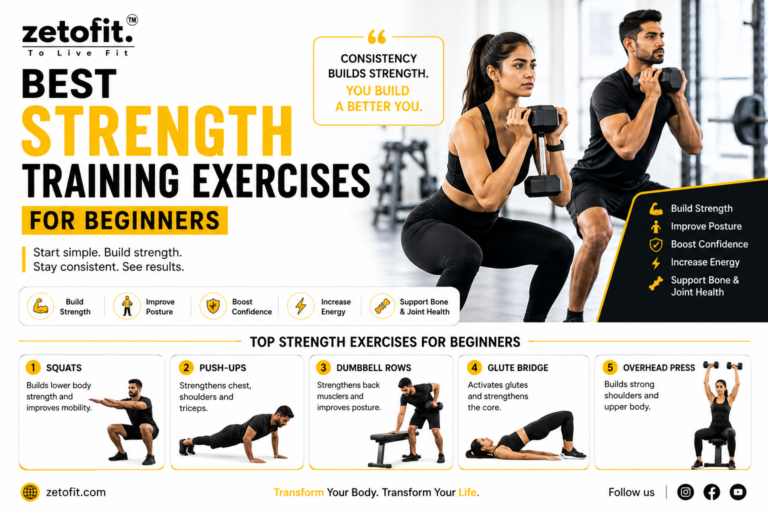
Good Beginner Exercises for Building Muscle
For your upper body:
- Push-ups or chest press
- Dumbbell shoulder press
- Seated or bent-over rows
- Lat pulldowns
- Bicep curls
- Tricep exercises
For your lower body:
- Squats
- Lunges
- Leg press
- Romanian deadlifts
- Glute bridges
- Calf raises
Compound exercises are especially useful because they train several muscle groups at the same time.
For example, a squat works your legs and glutes, while a row trains multiple muscles in your back and arms.
You don’t have to perform every exercise in a single workout. A balanced resistance-training routine can gradually work all major muscle groups over the week.
2. Focus on Good Form Before Lifting Heavy
One of the biggest mistakes beginners make is trying to lift heavy weights too soon.
There is no benefit in increasing the weight if your form starts breaking down. Poor technique can reduce the effectiveness of an exercise and increase your risk of injury.
Start with a weight that allows you to perform the movement with control.
Pay attention to:
- Your posture
- Range of motion
- Breathing
- Controlled movement
- Proper body positioning
Once you become comfortable with an exercise, you can gradually increase the challenge.
If you are unsure about your technique, working with a qualified trainer can help you learn the movements safely.
Weight loss can include water, muscle, and fat. Fat loss specifically focuses on reducing body fat.
For example, two people could each lose 5 kg, but the changes in their body composition could be very different. One person may lose a combination of water, muscle, and fat, while another may lose primarily body fat while maintaining muscle.
This is why a successful Weight Loss Coaching approach should not depend entirely on the weighing scale.
Why Does Body Weight Change So Much?
Your body weight naturally changes from day to day.
Factors such as:
- Water retention
- Salt intake
- Carbohydrate intake
- Food volume
- Digestion
- Exercise
- Hormonal changes
- Sleep
can all affect your weight.
Because of this, one day’s weigh-in does not tell you whether you have gained or lost body fat.
3. Use Progressive Overload
Your muscles need a reason to adapt.
If you perform the same workout with the same weight and effort forever, your progress will eventually slow down. Progressive overload simply means gradually making your workouts more challenging over time.
You can do this by:
- Increasing the weight
- Doing more repetitions
- Adding another set
- Improving your exercise control
- Reducing rest time when appropriate
You do not need to increase everything at once.
For example, if you are currently performing 10 repetitions of an exercise comfortably, you might gradually increase the weight once that level becomes easier. Making small, controlled changes over time is the basic idea behind progressive overload.
4. Train Consistently, Not Excessively
More training is not always better.
As a beginner, you don’t need to train every day to build muscle. Your muscles also need time to recover between workouts.
A beginner can start with around 3 to 4 strength-training sessions per week, depending on their experience, schedule, fitness level, and recovery.
For example:
Day 1: Upper Body
Focus on exercises for your chest, back, shoulders, and arms.
Day 2: Lower Body
Focus on your legs, glutes, and calves.
Day 3: Rest or Light Activity
Walking, mobility exercises, or gentle stretching.
Day 4: Upper Body
Repeat key upper-body movements and focus on improving your performance.
Day 5: Lower Body
Train your lower body again with good form and controlled intensity.
This is only one example. Your ideal routine should depend on your fitness level, available time, equipment, and individual goals.
5. Eat Enough Protein
Exercise gives your muscles the stimulus to grow, while nutrition provides the building blocks your body needs for recovery and adaptation.
Protein is especially important for muscle building.
Good protein sources include:
Vegetarian Options
- Paneer
- Greek yogurt or curd
- Milk
- Tofu
- Soy chunks
- Lentils and dals
- Beans
- Chickpeas
Non-Vegetarian Options
- Eggs
- Chicken
- Fish
- Lean meat
Instead of obsessing over complicated meal plans, try to include a good source of protein in your regular meals.
Your total protein needs can vary based on your body weight, activity level, training routine, and overall health. A personalized nutrition plan can help you understand what works best for your specific goal.
6. Don't Be Afraid of Carbohydrates
Many beginners make the mistake of cutting carbohydrates because they believe carbs will automatically cause fat gain.
Carbohydrates can provide energy for your workouts and help support your overall training performance.
Good options include:
- Rice
- Roti
- Oats
- Potatoes
- Fruits
- Whole grains
You do not need to completely avoid carbs to build a lean and muscular body.
The key is to look at your overall diet, portion sizes, activity level, and personal goals rather than labeling one food group as completely good or bad.
7. Eat Enough Calories for Your Goal
If your goal is to build muscle, your body needs enough energy to support your training and recovery.
Some people trying to build muscle may benefit from a small calorie surplus, while others, especially beginners with higher body-fat levels, may still make progress without intentionally eating far above their current intake.
This is why blindly copying someone else’s “bulking diet” is not always a good idea.
Avoid the idea that building muscle means eating unlimited junk food.
A better approach is to build your meals around:
- Protein-rich foods
- Fruits and vegetables
- Whole grains and other quality carbohydrates
- Healthy fats
- Enough overall calories for your individual needs
The goal is to support muscle growth without turning the process into uncontrolled weight gain.
8. Sleep and Recovery Matter More Than You Think
Your workout does not end when you leave the gym.
Recovery is an important part of the muscle-building process. Training creates the stimulus, while adequate rest helps your body recover and adapt.
Try to prioritise:
- Regular sleep
- Rest days when needed
- Proper hydration
- Managing overall stress
- Avoiding excessive training volume
If you constantly feel exhausted, your performance is getting worse, or your body is not recovering properly, your training plan may need adjustment.
Remember that building muscle is not about doing the maximum amount of work possible. It is about doing enough productive work and recovering well from it.
9. Track Your Progress
The weighing scale alone does not tell you whether you are building muscle.
Your body weight can change because of many factors, including food intake, water, glycogen, and body composition.
Instead, track your progress using several indicators:
- Strength improvements
- Workout performance
- Body measurements
- Progress photos
- How your clothes fit
- Energy levels
- Overall body composition changes
For example, if you are lifting more weight with better form than you did a few months ago, that is a positive sign of progress.
Common Muscle-Building Mistakes Beginners Should Avoid
Changing Your Workout Every Week
Your body needs time to adapt. Constantly switching exercises makes it harder to measure progress.
Training Without a Plan
Walking into the gym and randomly choosing exercises can make progress difficult to track.
Ignoring Nutrition
A good workout routine cannot completely compensate for consistently poor nutrition.
Trying to Lift Too Heavy Too Soon
Focus on technique first. Strength will develop gradually.
Skipping Recovery
Muscle building requires both training and recovery.
Expecting Immediate Results
Building muscle is a long-term process. Consistency over several months matters far more than one intense week of training.
A Simple Beginner Muscle-Building Plan
If you are just starting, keep things simple.
Step 1: Train Regularly
Start with 3 to 4 resistance-training sessions each week.
Step 2: Learn the Basics
Focus on exercises such as squats, presses, rows, lunges, and hip-hinge movements.
Step 3: Gradually Improve
Try to improve your performance over time by adding a small amount of weight, repetitions, or training volume when appropriate.
Step 4: Eat Well
Include sufficient protein, carbohydrates, healthy fats, fruits, and vegetables in your diet.
Step 5: Recover
Give your body enough sleep and rest between demanding workouts.
Step 6: Stay Consistent
Do not judge your progress after one or two weeks. Give your routine enough time to work.
How Zetofit Can Help You Build Muscle
Building muscle becomes much easier when you have a clear plan instead of constantly guessing what to do next.
At Zetofit, the approach to muscle building focuses on personalized training, progressive improvement, nutrition, and recovery rather than relying on generic workout plans. Individual guidance can be useful because factors such as your training experience, lifestyle, available equipment, and personal goals can all influence the right approach.
If you want a structured and personalised approach, explore Zetofit’s Muscle Building Program:
https://zetofit.com/muscle-building/
A personalised plan can help you understand what to train, how to progress, and how to structure your nutrition around your specific muscle-building goals.
Frequently Asked Questions
1. How long does it take to build muscle as a beginner?
The timeline varies from person to person. Beginners may notice improvements in strength and muscle development within the first few months, but significant physical changes require consistency over a longer period. Factors such as training, nutrition, sleep, genetics, and starting fitness level all play a role.
2. Can I build muscle at home without a gym?
Yes. You can build muscle using body-weight exercises, resistance bands, and dumbbells. The important part is challenging your muscles and gradually increasing the difficulty as your strength improves.
3. Do I need protein supplements to build muscle?
No. Protein supplements are convenient, but they are not mandatory. Many people can meet their protein requirements through foods such as eggs, dairy products, chicken, fish, tofu, soy, lentils, and beans.
4. Can I build muscle and lose fat at the same time?
Some people, particularly beginners or those returning to training, may experience improvements in body composition by building muscle while reducing body fat. The approach depends on factors such as your current body composition, diet, training experience, and goals.
5. How many days per week should a beginner train for muscle building?
Many beginners can start with around 3 to 4 strength-training sessions per week. However, the ideal schedule depends on your fitness level, workout intensity, recovery, and lifestyle.
Ready to Start Your Weight Loss Journey?
At Zetofit, we help you achieve sustainable results through personalized nutrition guidance, fitness coaching, and lifestyle support.
📞 +91 93018 55272 ✉️ contact@zetofit.com 🌐 www.zetofit.com
Book Your Consultation →Related Blogs
Intermittent Fasting for Weight Loss: Does It Really Work?
How IF works, its benefits, fasting methods, and beginner tips for sustainable results.
How Much Does a Nutritionist in Pune Charge Per Month
Monthly fees, packages, and what you should expect from a nutritionist in Pune.
How 16:8 Fasting & Intermittent Fasting Helps
Why the scale isn’t moving even when you’re eating less, explained.
About Zetofit
Zetofit is dedicated to helping individuals achieve sustainable health through personalized nutrition, fitness coaching, and lifestyle transformation. Our evidence-based approach focuses on long-term wellness rather than quick fixes.