
Starting strength training can feel intimidating, especially if you’re new to the gym or unsure which exercises to choose. The good news is that you don’t need complicated workouts or heavy weights to get started.
A beginner strength-training routine should focus on basic movement patterns, good technique, consistency, and gradual progression. You can use body weight, dumbbells, resistance bands, or gym machines. Current guidance from the American College of Sports Medicine (ACSM) also emphasizes that effective resistance training does not require a traditional gym setup.
What Is Strength Training?
Strength training, also called resistance training, involves making your muscles work against resistance. This resistance can come from:
- Your body weight
- Dumbbells
- Barbells
- Resistance bands
- Kettlebells
- Weight machines
Regular resistance training can improve muscular strength and fitness while supporting bone health and helping maintain muscle mass.
For beginners, the goal isn’t to lift as much weight as possible. Instead, focus on learning the movement correctly and gradually becoming stronger.
Zetofit tip: A healthy Weight Loss Program should focus on more than simply reducing the number on the weighing scale. Nutrition, physical activity, muscle mass, sleep, and daily habits all play a role in sustainable weight management.
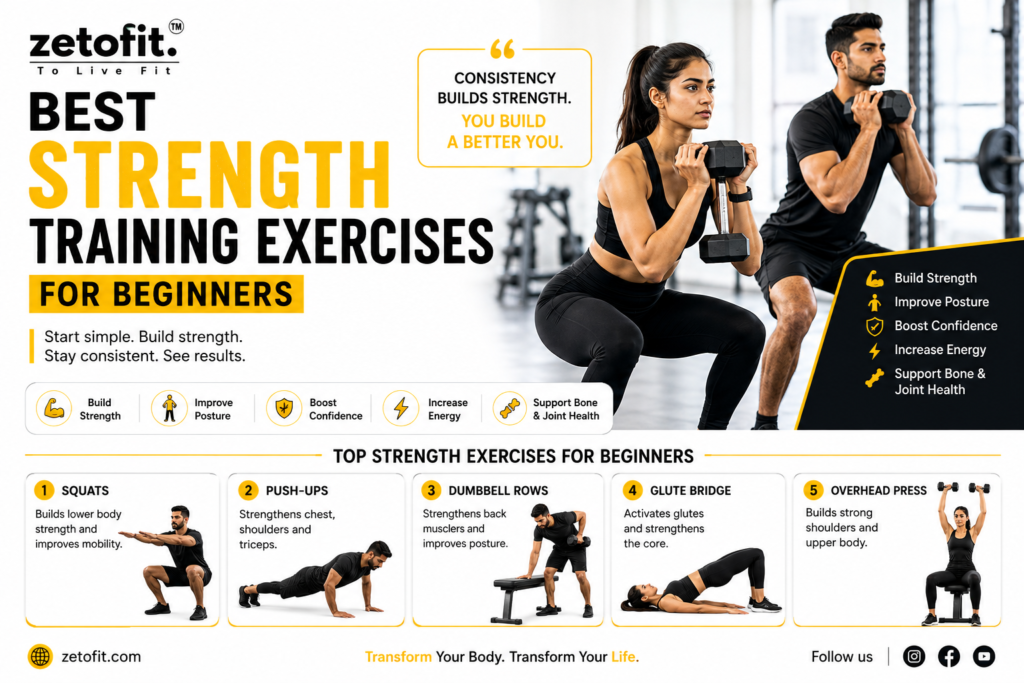
Best Strength Training Exercises for Beginners
Here are some beginner-friendly exercises that target the major muscle groups.
1. Bodyweight Squats
Targets: Quadriceps, glutes, hamstrings and core
The squat is one of the most useful lower-body exercises to learn because it trains a movement you use in everyday life.
How to do it:
- Stand with your feet around shoulder-width apart.
- Keep your chest lifted and core gently engaged.
- Bend your knees and push your hips back as if sitting into a chair.
- Lower as far as feels comfortable while maintaining good form.
- Push through your feet to return to standing.
Start with 8–12 repetitions and focus on controlled movement.
If bodyweight squats become easy, you can gradually add resistance using dumbbells or another suitable load.
2. Glute Bridges
Targets: Glutes, hamstrings and core
Glute bridges are a simple way for beginners to strengthen the muscles around the hips without needing equipment.
How to do it:
- Lie on your back with your knees bent.
- Place your feet flat on the floor.
- Keep your arms beside your body.
- Tighten your core and squeeze your glutes.
- Lift your hips toward the ceiling.
- Pause briefly and lower with control.
Aim for 10–15 repetitions.
3. Wall Push-Ups
Targets: Chest, shoulders and triceps
Traditional push-ups can be challenging when you’re starting out. Wall push-ups provide an easier variation while allowing you to practise the pushing movement.
How to do it:
- Stand facing a wall.
- Place your hands against the wall around shoulder height.
- Keep your body in a straight line.
- Bend your elbows and bring your chest toward the wall.
- Push yourself back to the starting position.
As you become stronger, progress to incline push-ups using a stable elevated surface and eventually regular push-ups.
4. Dumbbell Row
Targets: Upper back, shoulders and arms
Rows strengthen the pulling muscles of your upper body and help develop balanced strength.
How to do it:
- Hold a light dumbbell in each hand.
- Bend slightly at your hips while keeping your back neutral.
- Pull the weights toward your ribs.
- Keep your elbows close to your body.
- Lower the dumbbells slowly.
Start with a weight that allows you to maintain good form throughout the set.
5. Dumbbell Shoulder Press
Targets: Shoulders and triceps
The shoulder press is a simple upper-body exercise that can be performed while sitting or standing.
How to do it:
- Hold a light dumbbell in each hand.
- Position the weights around shoulder height.
- Press them upward without aggressively locking your elbows.
- Lower the weights slowly back to shoulder level.
Avoid using momentum to move the weights.
6. Reverse Lunges
Targets: Glutes, quadriceps and hamstrings
Lunges train the legs individually and can help develop lower-body strength and balance.
How to do it:
- Stand upright with your feet together.
- Step one foot backward.
- Lower your body while bending both knees.
- Keep your front foot stable.
- Push through the front foot to return to standing.
- Repeat on the other side.
If you’re new to lunges, hold onto a stable surface for balance.
7. Hip Hinge or Dumbbell Romanian Deadlift
Targets: Hamstrings, glutes and lower back
Learning the hip-hinge movement is useful before progressing to heavier deadlift variations.
How to do it:
- Stand with your feet approximately hip-width apart.
- Keep your back neutral and knees slightly bent.
- Push your hips backward.
- Lower your torso while keeping the weight close to your legs if using dumbbells.
- Squeeze your glutes to return to standing.
Start with very light weights—or practise the movement without weights—until the technique feels comfortable.
8. Plank
Targets: Core, shoulders and other stabilising muscles
Planks train your core to resist movement and can be performed almost anywhere.
How to do it:
- Start on your forearms and toes.
- Keep your body in a straight line.
- Brace your abdominal muscles.
- Avoid letting your hips drop or rise excessively.
- Hold the position while maintaining controlled breathing.
Beginners can start with a shorter hold and gradually increase the duration.
A Simple Beginner Strength Training Workout
You don’t need a long workout to begin building strength.
Try this full-body routine 2 days per week:
| Exercise | Sets | Repetitions |
|---|---|---|
| Bodyweight Squats | 1–2 | 8–12 |
| Wall or Incline Push-Ups | 1–2 | 8–12 |
| Dumbbell Rows | 1–2 | 8–12 |
| Glute Bridges | 1–2 | 10–15 |
| Reverse Lunges | 1–2 | 8–12 each side |
| Dumbbell Shoulder Press | 1–2 | 8–12 |
| Plank | 1–2 | 15–30 seconds |
As your fitness improves, you can gradually increase the number of sets, repetitions, resistance, or difficulty.
Current CDC guidance recommends muscle-strengthening activities on at least 2 days each week, working all major muscle groups, including the legs, hips, back, abdomen, chest, shoulders and arms.
How Many Reps and Sets Should Beginners Do?
A simple starting point is 8–12 repetitions per exercise for 1–3 sets.
The CDC notes that 8–12 repetitions can count as one set, with 2–3 sets potentially providing additional benefits.
You don’t need to train to complete failure on every set. Choose a resistance that challenges you while allowing you to maintain proper technique.
As the same exercises become easier, gradually increase the challenge.
How Often Should Beginners Strength Train?
For most beginners, 2–3 strength-training sessions per week is a practical starting point.
Allow your muscles time to recover between sessions, particularly when you’re new to resistance training.
You can combine strength training with walking, cycling, swimming, or other aerobic activities. Adults are generally advised to get at least 150 minutes of moderate-intensity aerobic activity each week, in addition to muscle-strengthening activity on at least two days.
How to Progress Your Strength Training
Progressive overload simply means gradually making your muscles work harder as you become stronger.
You can progress by:
- Increasing the weight slightly
- Adding repetitions
- Adding a set
- Using a more challenging exercise variation
- Improving your range of motion
- Performing repetitions with better control
You don’t have to increase everything at once.
The 2026 ACSM resistance-training guidance emphasizes consistency and gradual progression rather than complicated training methods.
Common Strength Training Mistakes Beginners Should Avoid
Starting Too Heavy
Lifting more weight than you can control can make it difficult to learn proper technique. Start with a manageable resistance and increase gradually.
Doing Too Many Exercises
You don’t need 15–20 exercises in one workout. A few well-chosen movements that cover the major muscle groups are enough to begin.
Ignoring Technique
Good form should come before increasing weight or repetitions.
Training the Same Muscles Every Day
Your muscles need recovery. Give yourself time between demanding strength sessions.
Comparing Yourself to Experienced Lifters
Everyone starts somewhere. Focus on improving your own strength and consistency.
Expecting Immediate Results
Strength and muscle development take time. Consistent training over weeks and months matters more than one difficult workout.
Can You Build Strength Without Going to the Gym?
Absolutely.
Bodyweight exercises, resistance bands, dumbbells, and home-based workouts can all be effective. The latest ACSM guidance specifically notes that traditional gym equipment isn’t necessary for improving strength, muscle growth, and physical function.
A simple home workout could include:
- Squats
- Glute bridges
- Wall or incline push-ups
- Resistance-band rows
- Lunges
- Planks
As you become stronger, increase the resistance or progress to more challenging variations.
When Should You Get Professional Guidance?
If you’re completely new to exercise, have an injury, experience persistent pain during exercise, or have a chronic health condition, consider speaking with a qualified healthcare professional or fitness professional before significantly increasing your training.
The CDC recommends discussing appropriate physical activity with a healthcare professional if you have a chronic health condition or are unsure what type or amount of activity is appropriate for you.
Final Takeaway
Strength training doesn’t have to be complicated for beginners.
Start with basic exercises such as squats, glute bridges, push-ups, rows, lunges, shoulder presses, hip hinges, and planks. Focus on good technique, train the major muscle groups at least twice a week, and gradually increase the challenge as your strength improves.
Most importantly, choose a routine you can maintain. Consistency matters more than having a perfect workout.
For more guidance on strength, nutrition, and muscle development, explore Zetofit’s muscle-building resources.
Frequently Asked Questions
What are the best strength training exercises for beginners?
Beginners can start with exercises such as squats, push-ups, lunges, glute bridges, rows, and planks to build overall strength.
How many days a week should a beginner do strength training?
Beginners can start with strength training 2–3 days per week, allowing adequate rest and recovery between workouts.
Can beginners do strength training at home?
Yes. Many beginner-friendly strength exercises can be performed at home using body weight, resistance bands, or basic equipment such as dumbbells.
How many repetitions should beginners do?
A good starting point is 8–12 repetitions per exercise, depending on fitness level and exercise intensity.
Is strength training good for weight loss?
Yes. Strength training can support weight loss and improve body composition when combined with regular physical activity and a balanced diet.
Ready to Start Your Weight Loss Journey?
At Zetofit, we help you achieve sustainable results through personalized nutrition guidance, fitness coaching, and lifestyle support.
📞 +91 93018 55272 ✉️ contact@zetofit.com 🌐 www.zetofit.com
Book Your Consultation →Related Blogs
Intermittent Fasting for Weight Loss: Does It Really Work?
How IF works, its benefits, fasting methods, and beginner tips for sustainable results.
How Much Does a Nutritionist in Pune Charge Per Month
Monthly fees, packages, and what you should expect from a nutritionist in Pune.
How 16:8 Fasting & Intermittent Fasting Helps
Why the scale isn’t moving even when you’re eating less, explained.
About Zetofit
Zetofit is dedicated to helping individuals achieve sustainable health through personalized nutrition, fitness coaching, and lifestyle transformation. Our evidence-based approach focuses on long-term wellness rather than quick fixes.